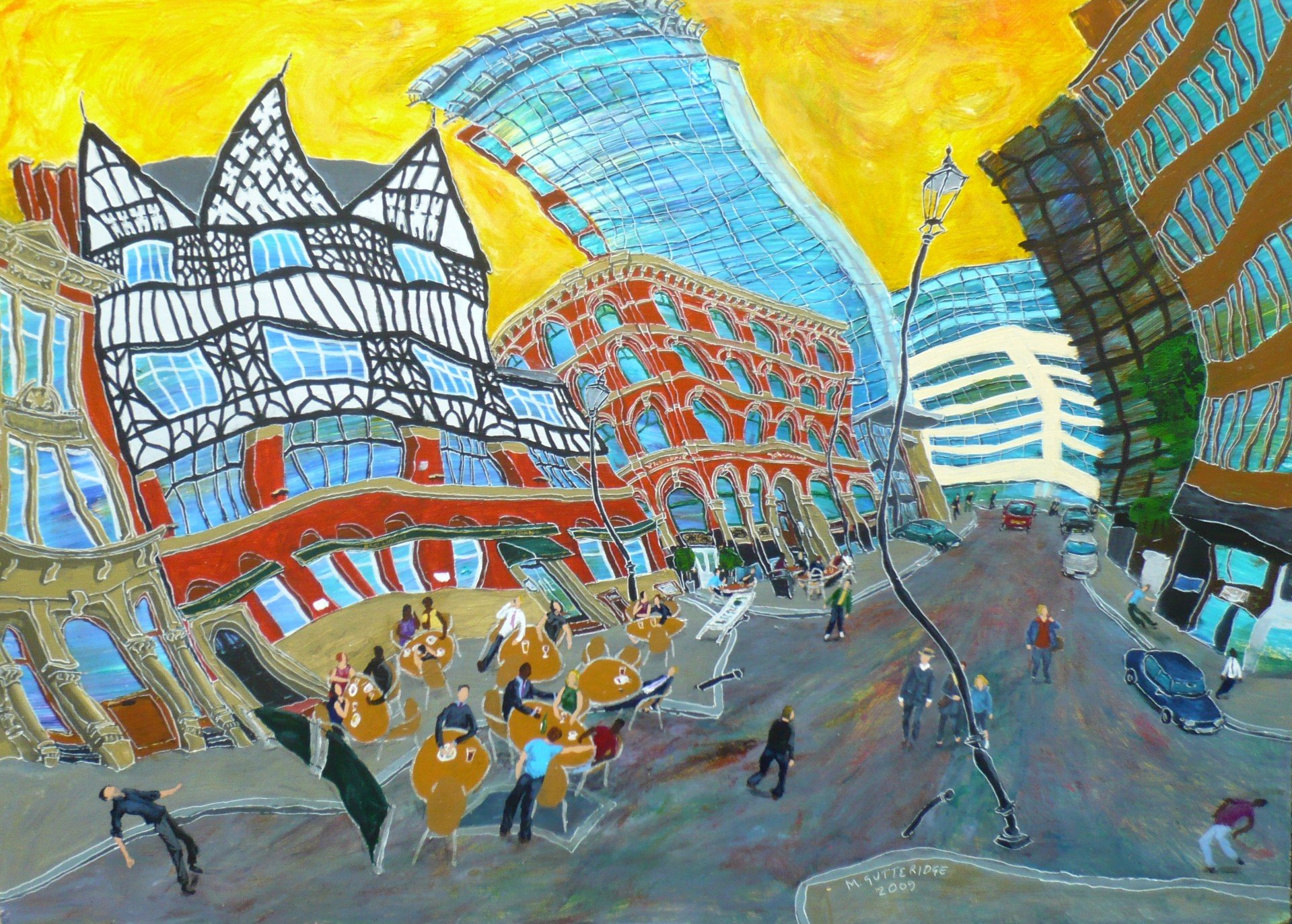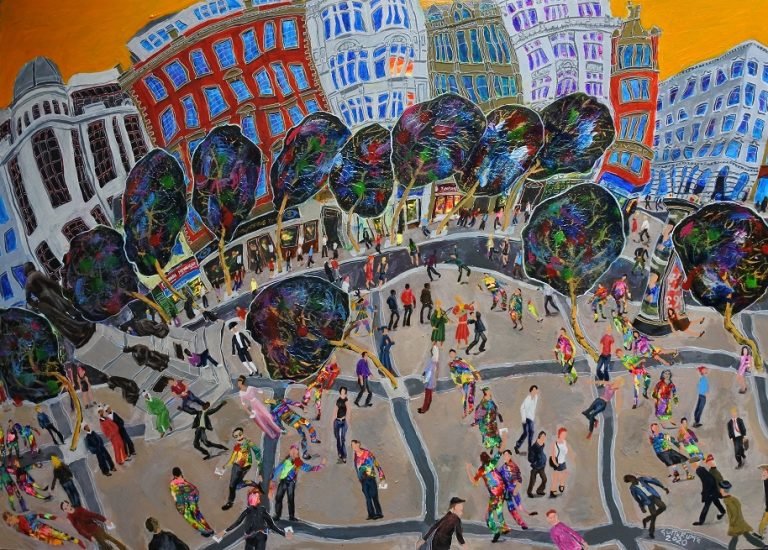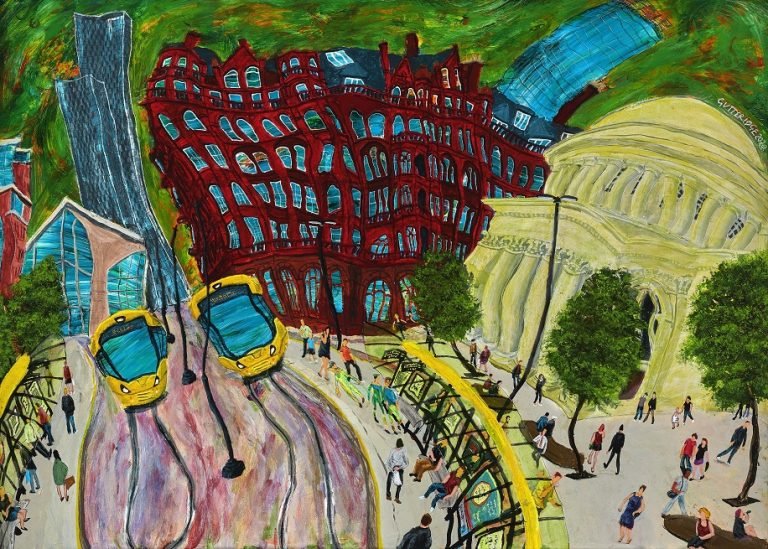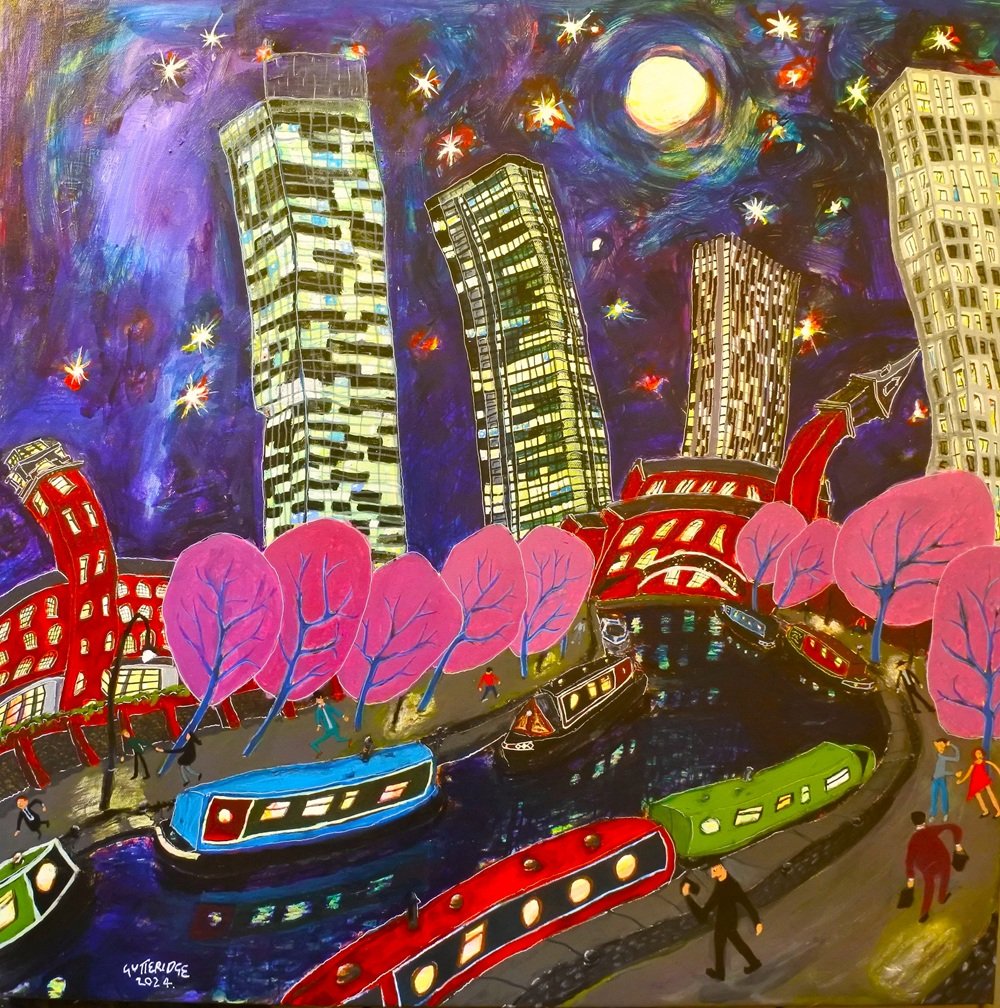
Gutteridge’s paintings present a cityscape in flux, where architectural certainty bends, twists, and sways under the pressure of perception. His expressive distortions disrupt the familiar urban order, creating an environment where buildings breathe, streets ripple, and the everyday world reveals its psychological undercurrents.
Michael Gutteridge
Each composition constructs its own internal logic: colours pulse with heightened intensity, perspectives skew into impossible alignments, and the inertia of city life becomes charged with an almost musical energy. Gutteridge disassembles urban reality not through fragmentation but through rhythmic exaggeration, expanding its emotional and metaphorical registers. His paintings form a vivid choreography of place, a visual echo of walking through a city while half‑lost in thought, memory, and sensation.
The central focus of Gutteridge’s work lies in its atmospheric tempo. Some paintings surge forward with restless, syncopated rhythms, echoing the overstimulation of modern life; others drift with a dreamlike languor, their warped geometries softened by luminous fields of colour. This tension between immediacy and introspection reveals the city as both a physical location and an inner landscape. In this refracted urban vision, uniformity dissolves into individuality—each street, building, or lamppost alive with its own character and behavioural logic.
SELECTED EXHIBITIONS:
Urban Distortions, Contemporary Six, Manchester, United Kingdom | City in Flux, Wendy J Levy Gallery, United Kingdom | Metamorphic Streets, Saul Hay Gallery, Manchester, United Kingdom | Collective Perspectives, Gallery Oldham, United Kingdom
AWARDS:
Shortlisted, GM Arts Prize | Exhibitor, Royal Academy Summer Exhibition | Manchester Open Award Nomination
Michael lives and works in Manchester.
“My work is rooted in the psychological energy of the city. I amplify colour, bend structures, and stretch perspectives to reflect the tension, movement, and emotion embedded in urban space. Buildings behave like characters; streets pulse like living organisms. The familiar becomes unfamiliar, not as fantasy but as an expression of how it feels to inhabit a rapidly shifting environment. By distorting what is stable, I reveal the instability underneath, showing how memory, mood, and personal history remake the city every time we walk through it.”
Interview: